Saturday, 4 June 2016

#30DaysWild - Day 3 - Sketching


I ran a revision session at work this morning and the weather was drizzling again. When I returned home, I walked through the park opposite our house and revelled in the scent of the wet soil. The hawthorn trees are in full blossom and the huge oak tree is a beautiful deep green. 

Later on, I found time to illustrate one of my nature diary entries from the last couple of days; one of our very cute pied wagtail fledglings, of which we have now seen three.


Thursday, 2 June 2016

#30DaysWild - Day 2 - Insect hotel


Today's wildlife mission, between the spells of drizzle and rain, was to install our recently purchased insect hotel. We might have missed the period for red mason bees (they've already decided to nest in the plastic tubes above our doors), laying their eggs and filling the entrances with mud. I am, however, hoping we might have put it up in time for leaf cutter bees during the summer months. I'd love to be able to sit and watch them taking segments of leaf, stuffing them into the entrances.


I've also planted some sweet peas to run up an arch that we inherited with the house. Hopefully the slugs won't eat them over night. I have taken some advice and scattered egg shell around the base of these young plants, which apparently will discourage the numerous slugs and snails.

Finally, when I was taking these photographs, I heard a stock dove in the neighbourhood for the first time. Their call is much more subtle than wood pigeons or collared doves. Maybe they'll be the next visitor to our wildlife garden.

Excitingly, my 30 Days Wild pack arrived in the post today - I'll definitely be wearing my badge proudly!


If you like the look of the bug hotel, it is called 'Elegance' and can be found on the RSPB website.


Wednesday, 1 June 2016

#30DaysWild - Day 1 - Wagtail fledglings


This is my first 'official' 30 Days Wild, and I'm hoping to write something every day about my random acts of wildness. Birds are where most of my knowledge lies at present, but I would like to use this month as an opportunity to develop my invertebrate and plant skills. I've always been obsessed with dragonflies, but have never mastered the art of identification. I also really want to teach myself more wildflower names and to identify at least a few species of bees. I do not think I will become an expert in only 30 days, but I'm hoping to make a good start. Saying that, Day 1 has begun with my comfort zone, although I am going to blame the weather for that!

The very un-June-like weather caused us to abandon our grand wildlife plans of venturing to Lakenheath Fen today, but our developing wildlife garden did not disappoint. As I've mentioned previously on my blog, we have recently moved house and now have a garden. Gradually, we are hoping to transform this into a wildlife haven. So far, we have several bird feeders which we brought along from our old flat, and a newly added bird bath. The shrubs and plants I am growing and planting should attract lots of beneficial insects eventually. Birds are our main visitors at present, with some new additions today. Even if the weather has not been spring-like, the bird behaviour certainly has been. We've had two pied wagtail fledglings in our garden for most of the day, either foraging themselves, or chasing one of the parent birds for food. They've been wonderful to watch and have been fairly trusting when we've needed to be outside. They're even more welcome if they are, as it appears from the photo below, feeding on slugs. I'm hoping we'll see more fledgling birds in our garden as the month develops.

Pied wagtail parent feeding a fledgling what appears to be a slug.

Sunday, 22 May 2016

Foxley Bluebells 2016

1st May - Foxley Wood

Spring is absolutely my favourite time of year, so it seemed fitting that on 1st May, I saw my first swallow of the year whilst on our way to see one of my favourite wildlife spectacles. The usually very private ancient woodland at NWT Foxley Woods bursts into life at this time of year, the vast sea of bluebells attracts so many visitors that it is impossible to get into the car park (there are usually a maximum of three cars when we visit). It is wonderful that one of nature's great events interests so many people.


I try to visit the bluebell woods every year - it's starting to be how I know spring has arrived. In addition, I love the assault on the senses that being in a flourishing bluebell woods brings. The perfume is extraordinary when it first hits you. New to me, though, were these white bluebells that we spotted - according to a quick google search, these are quite rare morphs of bluebell which lack the blue pigment (and I'm really hoping aren't a hybrid with the Spanish bluebell).


There were so many other signs of spring whilst visiting the bluebell woods. There were, of course, many other beautiful and subtle spring flowers; wood anemones, bugle, violets (although I am struggling to identify the species of violet...); and bees making the most of the bounty of nectar.


There were other invertebrate signs of spring too, comma and peacock butterflies would obligingly pause and sun themselves, whilst I also saw my first beefly of the year. These small and furry insects, with their absurd-looking proboscis always excite me in spring, although I never can quite figure out why.


Sunday, 17 April 2016

Some familiar places and a new local patch!

It's been about six weeks since my last blog update - it's been a bit of a busy time! We moved house during the Easter holiday and are settling in. That means we've said goodbye to our old local patch near the River Wensum and have a new local patch not far from the River Yare. In this update, I'm hoping to sum up our time at our old patch, introduce our new patch and take a tour of a familiar places during the mean time.

The old patch

We've lived in a flat in Norwich close to the River Wensum together for about 3 years. In that time, we've set up bird feeders in the communal gardens - attracting and sustaining quite large numbers of particular species (especially starlings and green finches). In the process we also accidentally created an ideal home for a family of wood mice in hole just beneath the feeding station. On walks around the patch, we've seen otters, woodpeckers, kingfishers and many woodland birds. Although most of the more uncommon species only showed themselves when I wasn't carrying my camera! We've seen a lot of wildlife in what we thought was an unlikely place in the city. I hope that our small population of birds will find ample food sources without us (I'm sure they will). We've also seen lots around our usual wildlife adventure areas, of which we've managed to visit a couple during the moving process...

Foxley Wood - 8th April

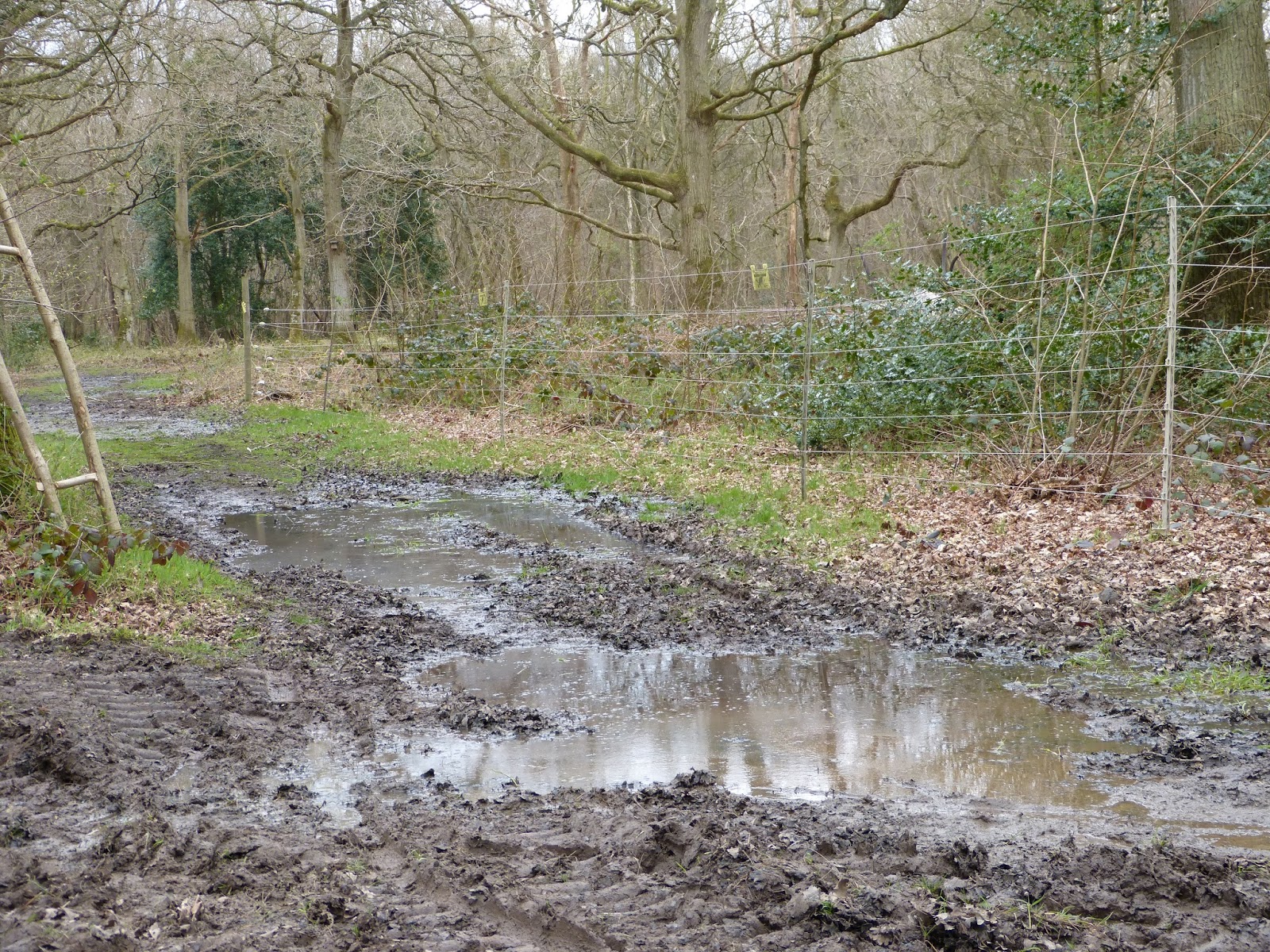
Just over a week after we moved to our new house and a few days before returning to work, we decided to escape the boxes, sorting and shopping and go on a hunt for bluebells at Foxley Wood. I had been hearing reports of early bluebells and didn't want to accidentally miss one of my favourite wildlife spectacles. It was a beautifully sunny day, but we hadn't considered quite how wet and muddy it would be after the thunderstorm the previous evening. It prevented us from reaching the bluebell hotspots, but we took comfort in that the patches of bluebells we did find were just coming into bloom. There should be a chance to go back before they are over. Pretty white blossoms adorned some of the trees and the sunshine had brought out a myriad of butterflies: brimstones, commas and peacocks basking and skimming over the unkempt grasses at the edges of the rides. A chiff chaff called in the background, heralding that spring had arrived with him. We stopped before the path became unpassable and listened: a buzzard calling in the background, tits and finches calling too each other. A sense of calm in the chaos of the last few days. 


Our new patch

We're not actually that far away from our old patch, but we are now in a house in the suburbs of Norwich. That means I now have a small garden which is pretty much just lawn at the moment - I'm itching to get started on transforming it into a wildlife haven. The very first thing we did when we arrived (and I really do mean the first thing!) was to put up our bird feeding station and fill it full of the normal delicacies. Not expecting anything for at least a few days, I was pleased that it had been found by a magpie, a pair of collared doves and a pair of woodpigeon within the first day. Not my intended audience, but still a good start. There is a park and a small woodland opposite the front of our house and when hanging washing out (is it sad that I am excited that I can do this?!) I can hear blue, great and coal tits, chaffinches, green finches and gold finches, even a chiff chaff and a green woodpecker, so I knew we'd get some smaller birds eventually. We've now been here for just over two weeks and we have regularly visiting birds which are slowly growing in numbers. The first were a pair of blue tits, then a pair of great tits, now we also have a pair of chaffinches and a robin. Hopefully the other birds I can hear will find their way across too. On walking around our local patch, we've discovered, to our delight that we can walk through the small woodland, which is absolutely filled with bird song. There is a mixture of mature and young trees and daffodils and English bluebells have been planted beneath them. The park leads to a path. On the corner, amongst a few trees, I have found a pair of nuthatches in the same place three times. I've decided I am going to call this 'nuthatch corner'. They are clearly used to people passing because on the third occasion, I took my camera and managed to get some decent shots of one of them.

 I'm hoping to keep updates of the new birds and other creatures that visit our garden and local patch and a record of my wildlife garden improvements - suggestions for plants are most welcome!

Sunday, 28 February 2016

Strumpshaw stomps

We've had a couple of nice walks around Strumpshaw Fen recently, despite the muddiness and diversions! Without wellingtons, some of the reserve has been inaccessible to us of late, leaving us to wander the woodlands, which we don't always visit, and spending more time at Fen hide.

Our trip during half term did not prove fruitful in terms of waders, but it was wonderful to watch a pair of marsh harriers above the reeds at Fen hide. The woodland was very quiet for birdsong, but we were lucky to spot a tree creeper at the very end of the woodland walk. I have not seen one of these well camouflaged birds in a long time, but this individual was very obliging, returning to the very base of the tree trunk before circling its way round and up, allowing for some good observations. I noticed only afterwards that I could see its tongue in the photographs I took.

The snowdrops were out in force, lighting up the woodland walkways like fairy lights. Amongst the dead wood and decaying leaves were also the vivid hues of the scarlet elf cap fungus.


Our second visit today was much later in the afternoon, in the hope of seeing more crepuscular animals. On arrival, we were told that a penduline tit had been showing well from Fen hide and if we stayed until dusk, we might be lucky enough to spot it. It was not to be, however.

The woodland walk today was much livelier than it was on our last visit, with bird song louder and more varied. A pair of coal tits hovered and hid among the upper branches of the coniferous trees, not far from where our tree creeper had been. The most surprising observation in the woodland was a seven spot ladybird perched on a trio of hazel(?) catkins. It must have ventured out during a milder spell, now trying to find a crevice to squeeze into in the chilly afternoon.

We walked back through the woodland and made our way to Fen hide. Here, we saw two marsh harriers gliding above the reed bed, then disappearing among the swaying golden fronds. At the same time, appearing from near the waterline, were Chinese water deer. They would appear and disappear silently into the reeds, with no betrayal of their loud vocalisations that we could hear only later when leaving the hide.


Tuesday, 16 February 2016

Valentines Day at Sculthorpe

It was a brisk morning on Sunday, but that didn't stop us getting some wildlife into our 'Valentine's Day'! It also didn't stop the wildlife from putting on a show, we had some great views of a variety of bird species. Unfortunately, my photos do not do our views justice!

The viewing panel looking over a variety of feeders near the information boards at the very start of the boardwalk is usually where we see the biggest variety of bird species, but there were fewer here today. There were a few blue, coal and great tits flitting to and fro, but that was the limit for this morning. Things got much more exciting after we arrived at the woodland hide.

Walking along the boardwalk we were somewhat sheltered from the cool wind, which may have explained the absence of a number of birds at our previous stop. Walking the woodland loop, we spotted a male siskin dining on nyger seeds strung high up in the trees. On reaching the woodland hide we were greeted with views of numerous chaffinches, greenfinches and tits. After around five minutes, everything in sight scattered. We knew there had to be something predatory around. It was at this point that a few other visitors entered the hide and we had to explain why we were looking so intently at a landscape devoid of birds. Suddenly a dark brown, arrow-like shape scythed into view and through the trees, causing all of the hidden smaller birds to flee to new shelter. A sparrowhawk. It deftly avoided branches and flew through gaps which appeared far too small. After several attempts, the hunter gave up and carried on across the surrounding fields. As soon as the finches and tits decided the coast was clear, they returned in force, calling loudly. The great tits were the first to venture forth into the open and onto the feeders, soon followed by the blue and long tailed tits. The long tailed tits were a pair chatting to each other, in calls I wouldn't normally associate with this species, in the short shrubs directly in front of the hide. It didn't take long for a pair of bullfinches to join in either. They began to defend their feeding perches from other birds. As the other birds began to disappear, a brambling timidly entered the scene and kept well hidden amongst the small leaves and branches.

The walk along the boardwalk was quiet in terms of what we could see, but birds could be heard around us. There was little to be seen at the Fen hide, but the new tower hide had some wonderful birds feeding outside the shutters looking over the woodland. A new bird for us was a lesser redpoll that joined a charm of goldfinches on one of the long feeders. A subtly beautiful little bird. A marsh tit also joined the feast. However, this hide was busy, so once we'd had a good view, we left and marched quickly back to the car in an attempt to warm up!