Thursday, 28 May 2015

Pensthorpe and Baby Birds

What better way to start off half term than with a trip to Pensthorpe? Eighteen wild bird species spotted, my first brimstone butterfly of the year and a multitude of just-hatched and young birds.

Before we even got through the gates of the reserve, we encountered a couple of mallard ducklings, frantically calling and wandering from water to land and back looking for their mother, only the second brood of ducklings I've seen so far this year. As we arrived quite late, we then went straight to the cafe, where, in a corner, there were communal nest boxes for sparrows, of which there were plenty and they were confident too, attempting to steal pieces of my scone from right under my nose!


We started off with a visit to the turtle dove breeding aviary. We both agreed that we could listen to the purring of these tortoiseshell and increasingly rare beauties. The bearded reedlings were also on good form, snuggling together amongst the reeds. There were also young corncrake and very tiny avocet hatchlings.


On entering the reserve proper, we, as we always do, fed their captive collection of wildfowl, then entered wilder territory. But, by their white-naped crane enclosure (who are still incubating a single egg, if you read my blog in April), there were a family of coots, including five youngsters, not long hatched from their size and comparative fuzziness! All were imitating the adult coots by preening and washing in the shallow water.


In the glorious sunshine, we walked under the archway of wisteria, emerging by one of the many lakes on the reserve. Suddenly, we heard a mechanical churring and singing from a waterside tree; a warbler which I could not differentiate by sound alone (I am still learning these magnificent songsters, but am struggling to tell them apart by both song and sight). I craned around different bushes, scanning them with both binoculars and camera to try to spot the bird. Eventually, I came across a reed bunting, but he was not the source of the melody. We had to continue on, but by chance, I stumbled across two of my marks, they turned out to be two reed warblers very low in the reeds by the pathway.

We continued on to head into the woodland and the bird hides, but before we could, we had to walk through gaggles of Canada, barnacle and greylag geese, five of which were greylag goslings. All were relaxing, sprawled out in the shade, apart from mother goose, who stayed very alert, keeping a wary eye on us as we passed. I knelt to photograph them and one gosling stood up and wandered towards us. Watching it walk and peck at the ground as it waddled along, with its tiny wings and oversized feet, really made me realise their similarity to their prehistoric ancestors, reaching back to archeopteryx and beyond.


There was little to be seen from the woodland bird hide, but a stock dove, a great spotted woodpecker and a grey squirrel graced us with their presence. After a five minute stint in the hide, we continued on rather briskly, realising that we didn't have long before we needed to depart the reserve and head home. But, on our return walk, we were rewarded with great views of a great crested grebe preening and apparently 'dancing' next to the wave garden. A fantastic end to our visit!


Monday, 25 May 2015

Butterfly rearing and releasing

For the second year, I decided to buy in some painted lady butterfly caterpillars to rear in my lab on my nature table at work. Last year, the pupils loved watching them develop and emerge as butterflies, so I thought I would try it again. Little did I know that this year, they would get 'lost' in the post, arriving a week late and looking like monsters already! We did still watch them grow and develop for a week before they became chrysalises though. When they reach this stage, they have to be transferred to their 'hatching habitat' to stop their wings getting trapped. I had forgotten how much these seemingly motionless hanging brown blobs could wriggle when threatened!


My STEM Club of three found them fascinating and wrote some observations of the caterpillars on a few different days. For the first time ever, I actually saw one emerge from its chrysalis; the process took much less time than I imagined - a wriggle, a tear, then out within 30 seconds! A little bit longer to pump up the wings using meconium, which is then expelled from the abdomen, but still completed within no more than 20 minutes or so.

The bit my pupils enjoyed most though was releasing them. This year, the butterflies hung around for longer, fueling up on nectar before disappearing for good. We got to watch them fly, then float towards the dandelions and daisies on the school field. The pupils watched them unfurl their proboscis' and sip nectar, like drinking through a straw. Eventually, we decided to leave them be and hope that the sun continued to shine so they could finish fueling, warm up, disperse and continue the battle for survival.

Still inside the hatching habitat before being released

Sitting on the hand of a year 7 member of STEM Club

Sipping nectar using its very visible proboscis!

Sunday, 24 May 2015

Spring Migrants Workshop at Cley Marshes

It was a blustery day, but the rain held itself at bay as we went to an interesting and informative workshop about the migrant birds passing through Cley in spring. There were eight of us in the
workshop, of varying levels of expertise, but we all found it eye-opening in one way or another.

Our day began with an indoor seminar-like session which introduced us to the key identification features of birds we were likely to (or hoping to) see on the marsh. The rest of the day was spent out on the marshes looking for these critters and pointing out these features in the field. We saw (or heard) a total of 35 different bird species, including a number of firsts for me. Here's the list of what we saw, with a few photos and details:


  • Sandwich tern - these slick birds were much louder than their charismatic and slender shapes suggest they should be.


  • Little tern - only one, obvious amongst the larger and shoutier sandwich terns.


  • Avocet


  • Lapwing with chicks - certainly winning the 'cute' prize of the day


  • Black-headed gull


  • Little egret


  • Mallard


  • Gadwall


  • Greylag geese with goslings


  • Black-tailed godwit


  • Bar-tailed godwit - a surprise siting, even for our guide, who didn't include it in his earlier presentation due to the unlikelihood of us seeing one.


  • Red shank


  • Spotted redshank


  • Ringed plover


  • Little ringed plover


  • Curlew 


  • Skylark


  • Oystercatcher


  • Ruff - the first time I have ever seen these beautiful birds, I had no idea about their huge variation in plumage, with each we saw being an 'improvement' on the last.


  • Dunlin


  • Sanderling


  • Swallow


  • Swift


  • House martin


  • Sand martin


  • Shoveler


  • Shelduck


  • Pied white wagtail - another bird that I take for granted, but today I learnt about the different races of this unassuming bobbing bird.


  • Mute swan


  • Marsh harrier


  • Kestrel


  • Reed warbler - heard only among the reeds


  • Sedge warbler - again, heard only


  • Lesser whitethroat - deep inside a road side hedge, another of our heard only birds.


  • I certainly felt more educated about our migrant birds and our more common wading birds and warblers by the end of the day, although it did also make me want a much better pair of bins! Let's hope at least some of my new gained knowledge sticks!


    Sunday, 10 May 2015

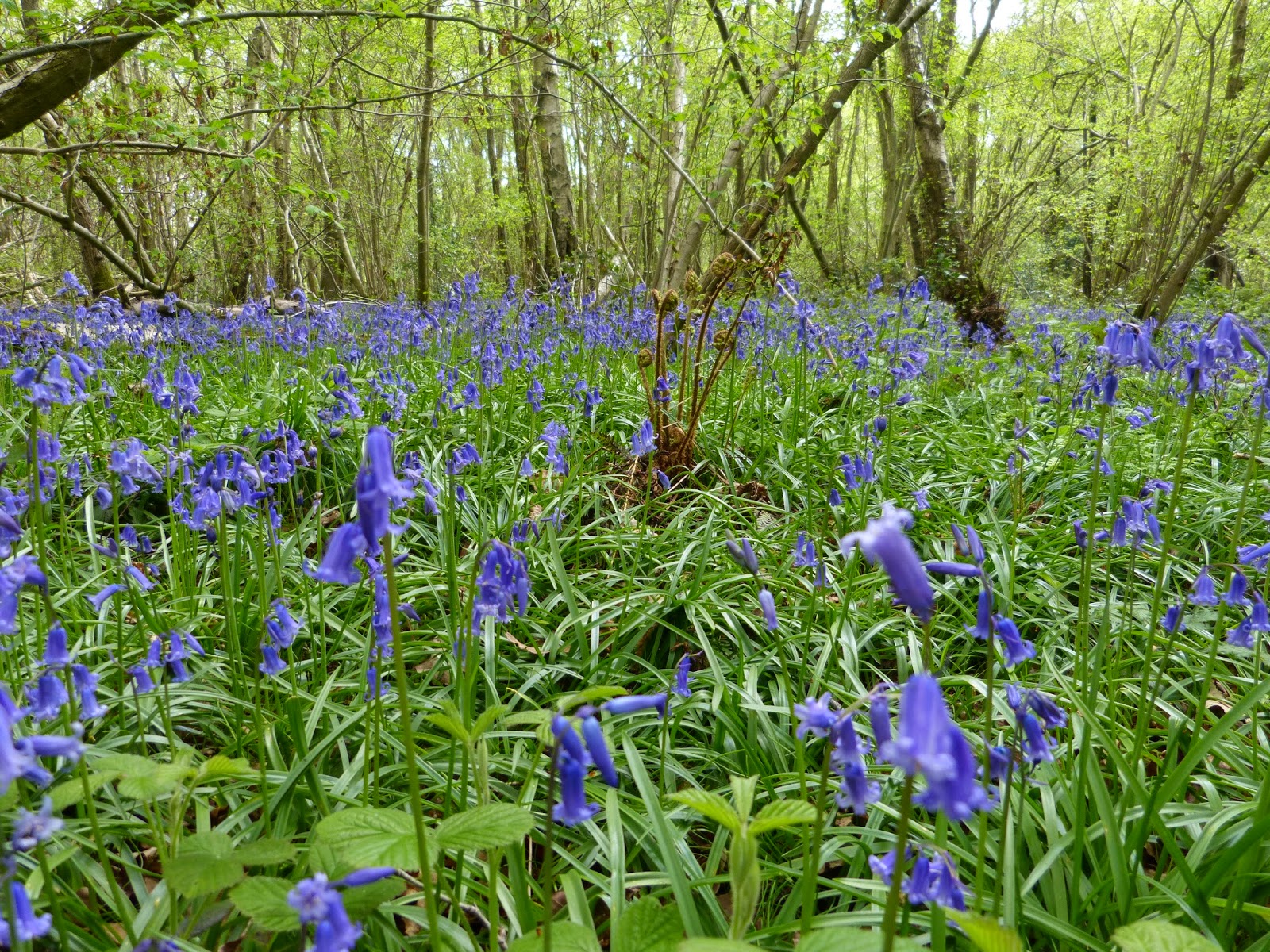
    Foxley Bluebells

    This time last year, I was really sad - I had managed to miss the overwhelming displays of bluebells in Foxley Woods by a week. This year, I made sure I didn't miss them; I visited once a week for the last three weeks, seeing the bluebells and indicator flower species at varying stages.

    We first visited on 19th April. The blue of the knodding heads was just starting to emerge and the intoxicating sweet smell was only evident at point blank range. Wood anemones and wood sorrel were in full bloom, their open white/pink faces all the more obvious amongst the blue and green of the woodland floor.


    Our walk had the sound track of chiff chaffs and was painted the blue of bluebells, the white and pink of wood anemones and wood sorrel and the yellow of the few remaining primroses.

    When I returned the following weekend, the blue was all the more intense for the overcast sky and little sunlight penetrating the woodland. The bluebells were now at the stage where you could walk around a corner and be hit by a wave of their perfume, smelling almost like nothing else.

    Our last visit, on 4th May, saw the bluebells at their showiest. It was the busiest we had ever seen the woods. Usually, ours is one of only two or three cars in the carpark, but today, it was overflowing, as it probably had been all weekend. A sure sign that the flowers were in full bloom and calling to all those who could hear them.

    The blue was now so intense that I kept having to double-take the woodland floor, such an alien colour to be surrounding us in all directions - surely it should all be a greeny brown, not such a rich and showy colour!? The sunlight hitting the floor did not bleach them out, as expected, but made the contrast to the dark and mossy trees all the more apparent, and made the bluebells stand out all the more, not that they needed any help.


    This has to be one of my favourite and most treasured wildlife spectacles. One that I am determined not to miss again.


    Sunday, 3 May 2015

    Ecologists reunion at Sculthorpe Moor

    Well, a small reunion of five university friends, a mixture of ecologists and environmental scientists; although we were complimented by being asked a number of times if we were all students, despite us all graduating four to five years ago.

    Only my second visit to the reserve, and the first for everyone else, we were again spoiled for the abundance and diversity of wildlife we saw. To start off our afternoon, there was a mistle thrush in the trees surrounding the car park, the first I have spotted in a very long time. The three of us who travelled in the first car stood in the car park and absorbed the surrounding birdsong until the second car arrived.

    The air was cool and the sky patchy as we walked along the dusty track to the reserve entrance and the first viewing panel. This was the most fruitful location for birds on our first visit here; I was disappointed at the emptiness of the space when we arrived this time. However, we were soon treated to a range of avian visitors, as were we at the Frank Jarvis (Woodland Hide); a proud mother mallard with four ducklings; marsh, coal, blue, great and long tailed tits; treecreepers, nuthatches, green- and chaffinches.


    Crossing the bridge from dry wood to wet wood, a collection of other visitors were watching a hole in the river bank. Finding it unlikely to be a water vole as the hole seemed far too small, we stood, watched and waited until a whisp of brown fur pelted up the bank and into the hole, then back again, slipping silently into the water of the dyke. We watched the exploits of this water shrew until it disappeared into a different hole and out onto the bank into the mid-length grasses. The first water shrew I've knowingly seen, we saw another preening itself on the bank of dry wood / fen near the dyke viewing platform; small, fluffy and unquestionably cute, this too slid noiselessly into the water and disappeared.

    Along the edges of the boardwalk, one friend was constantly excited by the invertebrates she was coming across and photographing, but my excitement was for the first Odonata I've seen this year: a large red damselfly. From her colourings; very dark abdominal segments and yellow antehumeral stripes, I would guess at a female of the melanotum colour form. Another highlight of the walk to the Fen hide was the 'mole fortress', a treasure that I had no idea even existed. Apparently, a large structured molehill which allows the mole to escape wet conditions when on land liable to flooding, the elevated 'fortress' gives the mole a high, dry and safe refuge.


    From the Whitley (Fen) hide, we were treated to a pair of nuthatches foraging; reed buntings; three bullfinches (one male, two females); majestic circling marsh harriers, which we later found out were prospecting nest sites, causing the path to the scrape hides to be closed, and a buzzard which allowed us several flybys. A tour had finished here too, they told us that they had seen a cuckoo and a red kite, which unfortunately we had not, but it's good to know they're there.


    The more I visit this reserve, the more I fall in love with it. Friendly volunteers around the park to point out species and help with i.d., wildlife all over the place, from the 'common' to the obscure and a beautiful habitat. What more could I ask for?

    Sunday, 12 April 2015

    Changes of season

    During the Easter holiday, we have visited Taunton, Cambridge and a few places in Norfolk. Now, I have already mentioned my first chiff chaff of the year in my blog last week, but there have been substantially more changes that I've been noticing.

    The first has been the crocus, one of my favourite flowers, passing its center stage position to the primrose, both wild and cultivated. They have gone from being slightly folorn, like this example in Taunton at the beginning of the two week break, to prolific blooms all over the place now. It goes to show what a significant change only two weeks have made to our plant life.

    Unfortunately, these blooms came too late for one of our beehives at school. Although one is big and happy, the other hive seems to have starved, despite us providing it with food. Whilst checking the hives during the holiday, I also saw that our oystercatchers have returned, all three of them. Perhaps we will get see them breed successfully this year...

    Other changes have been not only been due to the season, I feel, but perhaps to a change in food availability. Growing up in Cambridge, I can always remember the flocks of house sparrows and starlings we would have in the garden and nesting under the tiles of the house next door, along with a few blue and great tits. Now, my parents garden is host to a full range of birds, 15 species I counted on our Easter weekend visit, including a male black cap; a bird I rarely see and one neither of my parents had ever seen before. Is this due only to my suggestion of putting out sunflower hearts as a food source? Or is it due to the development of areas of previously 'un-utilised' land that has driven them into the city and gardens for food?

    Our birdfeeders outside our flat in Norwich are bursting with life now too. The green finches have returned post winter; we have at least two healthy looking pairs, with squabbling males and nonchalant females, with the odd copulation on the fence. A few goldfinches have finally crept back in after the winter months, and our first ever chaffinches, who are clearly not used to using bird feeders, have arrived. I was distracted from my school work only a few days ago by a feisty long tailed tit who had decided to perch on the window frame and peck at our windows, sounding like he was asking to be let in.

    I'm looking forward to the arrival of more birds as the migrants continue to arrive, but the botanical spectacle I'm now waiting for is the explosion of bluebells at Foxley Woods...

    Monday, 6 April 2015

    The First Chiffchaff

    It's Easter and it appears spring is all around. On a visit to Pensthorpe with a dear friend a few days ago, from the moment we entered the woodland to the time we left the reserve we could hear the same familiar call of spring and summer: "chiff-chaff... chiff-chiff-chiff-chiff-chaff". This was my first of the year and, for me, it is one of the harbingers of spring.

    We had fun, as per usual, feeding their captive collection of wildfowl, but the real treats were when we reached the 'wild' end of the reserve and watched from hides and walked through woodland. A small muntjac trotted past us, seemingly oblivious to our presence. Oystercatchers also seemed to feel the vibe of spring, as what appeared to be one sneaking up on another, turned out to be a more amorous encounter...


    Across the several lakes and from the hides at the scrape, we spotted numerous other waterfowl; tufted ducks in good numbers, avocets preening and dabbling, shelduck sporting their shocking red bills and lapwing beginning to perform their tumbling display flights with their beautiful bubbling call. Pretty little barnacle geese were also sunning themselves on the grass, and beneath the captive white naped cranes, we spotted two mottled brown eggs. Their is something joyous about witnessing these early stages of life being 'created', and seemed especially fitting for a trip preceding Easter weekend.

    Another befitting Easter symbol was the tiny baby rabbit, which could easily have fitted on the palm of my hand, who could only be betrayed by his hiding place in the fork at the base of a tree by his two hind feet jutting out. Apart from that, in colour, it was perfectly camouflaged, so I hope it escaped the beady eyes of any passing predator. This bunny was just outside the woodland hide, where we were treated to flocks of chaffinches, listening to their spinking calls, greenfinches calling "zveeeeeee", the sweet drumming of a great spotted woodpecker who also momentarily flew into view, a treecreeper who came tantalisingly close to the viewing panel and many of the other usual woodland birds hoovering up seeds.

    Walking through the woodland, we played a game of hide and seek with both chiffchaff and nuthatch, both of whom would fly into sight and disappear among the shadows of branches and twigs, making us doubt our own vision, until they would appear again, just a little further along and vanish almost as instantly. A small dynasty of goldcrest played the same game with us, softly calling in their high pitch tones, they would only betray themselves occasionally by zipping from one branch to another.

    At the end of our visit, we decided to enter the aviary where turtle dove and bearded tits can be found. Never having seen either of these species in the wild, I find the purring of turtle doves strangely electrifying; so familiar, yet exotic compared to our other doves. Bearded tits I adore, and are one of the species that I long to see in the wilds of Norfolk. However, I couldn't resist an 'awww' shot of this couple snuggled together in front of the nesting reeds. I may make these my 2015 challenge to see in the wild.