Tuesday, 15 April 2014

Sleeping Sandpipers and Broody Blue Tits

Spring in Southsea

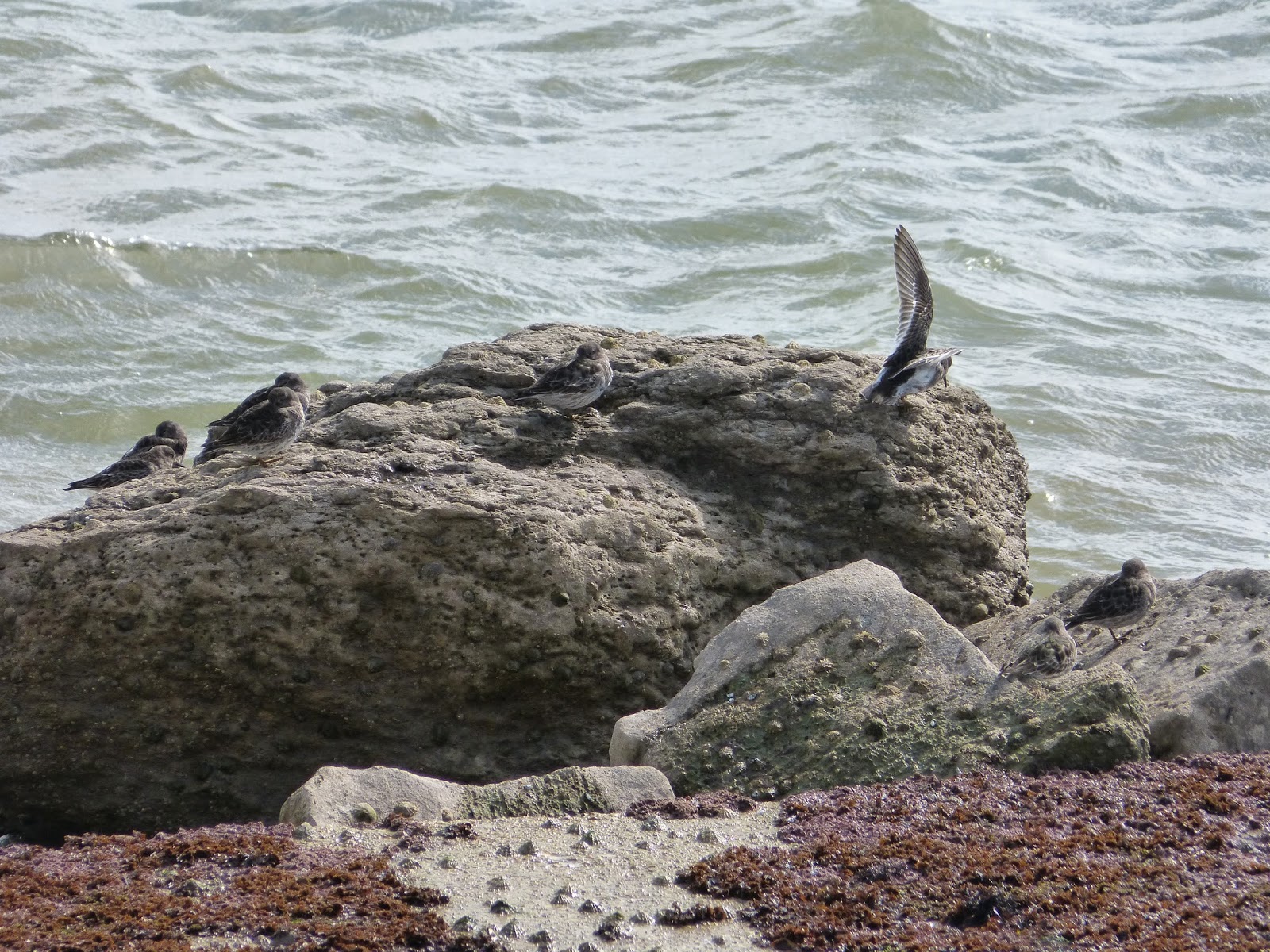
Being so close to the sea is always a treat when we visit Southsea. We had a few walks down to the seafront, and I was very happy to see, on every occasion, a little flock of purple sandpiper - even if they were always dozing! It seems that we are very lucky to see them here, I hadn't realised quite how lucky we have been; according to the distribution maps, they shouldn't really be here. I would assume that they won't be here much longer either, spring is well and truly on it's way and they should be heading back to Northern Europe to breed.

I also decided to do some bee-watching in the back garden; there seemed to be no end of different species, none of which I could be sure of. The only one that obliged to be photographed by staying still long enough was this little hover fly, Myathropa florea. Thank you again people of iSpot for helping to identify!

Myathropa florea


Spanish bluebell

Spring in my Local Patch

We haven't walked around our local patch, the water meadows just off the A140 (see my-local-patch), in a good few weeks, so the change in vegetation cover has been pretty spectacular; everything is very green! Even the bluebells are out, although they are Spanish bluebells, Hycacinthoides hispanica, rather than our native bluebells. I have only really started to pay attention to the differences this year, and I am hoping that when we do visit my favourite woods at Foxley, I will find they are at least mostly native ones! On of the best places I have found to aid identification is here: www.plantlife.org.uk.

I had a few other sightings on our walk yesterday, and another first for the year; a large white butterfly, Pieris brassicae, that settled and allowed a photo or two. I was also at work in Reepham today and saw my first orange-tip butterflies of the year, but unfortunately I was not equipped with my camera, nor was I fast enough to follow them!

Large white butterfly

I have also been on the lookout for frogspawn, but have failed to find any as yet. About a month ago, we saw a huge number of common frogs mating in the side-shoots from the river Wensum that runs through our local patch, so I'm remaining hopeful that we might find some soon.

All of a sudden, the trees seem to be full of grey squirrels, and they are certainly not being shy or retiring! Everywhere we look there seem to be squirrels performing acrobatics and generally being loud and boisterous. One stayed still just long enough for a photo.


Grey squirrel

Even more local, in our car park, a collared dove seems to have picked the most exposed place to build a nest, in the fork of a rather bare birch tree, and right at the entrance to the car park... She's been incubating for over a week now, so hopefully we'll have some cute and fluffy chicks soon.

Collared dove nest

Spring at School

Staying on the theme of nests, I have some very good news about our school bird box. We've been watching the blue tits hopping in and out, beginning to build then changing their minds about what to use, and now, finally, we can see the fruits of their labour. There are at least six eggs in their nest as of today, much to my excitement, and to the excitement of some of my year 12s who were in school revising. The female is not yet incubating, so I'm hopeful that she will lay more, and I am equally hopeful that we will not miss too much over the next week of the holiday!


Tuesday, 8 April 2014

Spring Strumpshaw Spectacles

It's official. Spring is here! The swallows, house martins and sand martins told me so at Strumpshaw Fen today. It wasn't only members of the Hirundinidae family we saw either, the marsh harriers were out in full force, as were some common lizards that appeared out of nowhere. You can see all of the species we spotted in my diary entry here, along with a couple of sketches for #dabday (Draw A Bird Day) today.


It was beautiful, if breezy day, and as I was a with a friend who had not been to the reserve before, we had a long stomp about, down all of the possible paths and visited both hides. There seemed to be marsh harriers in whichever direction we looked; often with at least four in the sky at any one time. One was carrying something around in his talons whilst we were watching, possibly nesting material. Even though you're almost guaranteed to see them here, today was spectacular for views of them in flight.


One of the marsh harriers

Pair of marsh harriers circling
Our other surprise finds of the day were three common lizards hiding on a little track, two of which gave us enough time to take a few shots!

Common lizard basking in the sunshine
In the woods we also saw two nuthatch clambering up two trees, another first for the year for me. There were also several pairs of great crested grebe on the water. It is amazing the difference that only a few weeks can make; last time I was here, it was cold, muddy, wet, and although still a beautiful place, very brown. Today, it was bright, green and had that beautiful earthy and boggy smell wherever we went. The birds were all in full song too, even if they didn't always show themselves. There were even a few bluebells starting to show their nodding heads. I think our next visit will have to be the ancient woodland of Foxley Woods to see the carpets of bluebells. I'll keep my fingers crossed that they are as spectacular as last year!


Blue tit update:

As of Monday 7th April, this was the progress made by the blue tits in their nest!


Wednesday, 2 April 2014

Wildlife at Work

This is my first proper post about attempting to get the pupils I teach involved in wildlife, so for those of you who are not familiar with the school environment, I will give you a short introduction. Schools are interesting places to work. Each day is never quite the same, they can be brilliant, and they certainly have their challenges too. But, unlike some would lead you to believe, it is not all doom and gloom! We do have fun (pupils and staff alike), and there are lots of opportunities to get involved in almost anything...

2013 and 2014 Big Schools'
Birdwatch certificates
I run STEM Club at my school, that is 'Science, Technology, Engineering and Maths' Club. As part of this, I have managed to purchase and set up some great wildlife resources, like a bird box with installed camera that my tutor group and I are keeping close tabs on, and our bird feeders that are set up near the library -  a big help for the Big Schools' Birdwatch!

Noctuid moth chrysalis'
I also have a pop up 'butterfly garden'. I am planning on ordering the painted lady caterpillars that come as part of it soon, but at present I am guardian of seven moth chrysalis' (I've recently learnt they are not cocoons, because cocoons are the silky protection around the chrysalis). They have been in hibernation since the beginning of December, just after the caterpillars were saved from the greenhouse and delivered to my lab. After doing some research, it seems they may be Noctuid or owlet moths, but with over 35,000 known species of this type of moth, I think I'll have to wait until they emerge to really find out what they are!

We are also having discussions about what we're going to do with our 'wildlife garden' and 'nature area'. The wildlife garden once had a pond, but hasn't for a long time, and we want to get it back to how it should be, with a complete pond and wildflowers to make it a haven for wildlife once more. That will then make it a brilliant resource for the ecology based projects that the science department carry out, and as an extra-curricular resource too. Our nature area also has some fantastic aims; there will be raised beds to grow fruit and vegetables, there are the beginnings of an orchard, and there will be swathes of wildflowers to help the honey bees that we keep. This is a fantastic time because we are just starting to flesh out our ideas about exactly what to include and how we're going to do it, and the pupils will be helping us a lot with that.

I will finish with some of the action from our bird box thus far - the blue tits have been very busy this week, today in particular, and their nest seems to be almost ready! They are causing so much excitement, even in our year 11 and sixth form classes. Anyone walking down the corridor must wonder what's going on when there is a sudden "Oh! There's a BIRD!"
Date: 17th March 2014

Date: 18th March 2014

Date: 18th March 2014

Date: 18th March 2014

Date: 18th March 2014

Date: 31st March 2014

Monday, 24 March 2014

Buckenham Marshes and UEA

It's been a while since I've had a moment to update my blog, what with all the exciting things that have been happening, so this may be a little long!

The Havergate Hares

Buckenham Marshes - 23rd March 2014

About a year ago today I decided I wanted to see brown hares in the wild because I really had never seen one before. One of my favourite characters in Alice in Wonderland has always been the Mad March Hare. We decided to go to Havergate Island in Suffolk, and we were not disappointed; although the hares were decidedly chilled out and seemed to have no inclination to entertain us by boxing.

I was inspired to try to see them again this year, so I checked out the best place to see them on the BBC Wildlife Magazine website (www.discoverwildlife.com). Unfortunately, Havergate seems to have been hit badly by storms during the extreme weather this winter, so we decided to try somewhere closer to home, but still somewhere we hadn't been before. The RSPBs Buckenham Marshes seemed like the perfect place, only a stones throw away from one of usual local patches, Strumpshaw Fen, and seemingly full of wildlife (www.rspb.org.uk).


Lapwing at Buckenham
The hares were nowhere to be seen this weekend, but I don't blame them. Whilst we were there, the weather turned from glorious sunshine to biting wind and torrential rain. We still saw some pretty amazing things though. Our first spot were the lapwings. I've always loved these birds since I spotted them for the first time at Cley a few years ago. Their tumbling display flights with alternate flashes of their black and white wings and beautiful bubbling calls, along with their usual pee-wit, are enchanting.

Little egret
Lapwings were not the only beautiful birds present at Buckenham though. I also saw my very first wigeon - and there were thousands of them. I have no idea how I have managed to not see these birds at all during the seven years I have lived in Norfolk. These little birds with their gorgeous auburn heads and their gold highlights are adorable. A snow white little egret also graced us with its presence, as did a number of shovelers, teal, shelduck, greylags, redshank, linnets, moorhen, coot, mute swans, a grey heron, a kestrel and a marsh harrier.


Wigeon at Buckenham

Mixed flock (or raft, as a group of ducks are apparently called on water) at Buckenham, mainly wigeon

A shoveler pair at Buckenham


Kestrel perching near the car park

Common linnet perching in the car park

The Broads at the University of East Anglia - 16th March 2014

I've gone from somewhere new to somewhere familiar with this post. I studied for my BSc Ecology degree at the University of East Anglia, and I have many fond memories of walking around the UEA 'lake' (really a part of the broads) and the surrounding woodland for bird spotting and bird ringing with the other ecologists. I also remember several of them being exasperated with me for not being able to tell the difference between the various warbler species by their song (... I still can't). Along with warblers, it was also where I spotted my first black caps and whitethroats.

On this visit, we didn't see any of the above, but it was a sunny spring day and there were butterflies and blossoms aplenty. Along with a chiff chaff singing his heart out, some robins and long tailed tits, great tits and chaffinches.

The broads at UEA

Small tortoiseshell

Blackthorn blossom

Willow catkins

Posing chaffinch
I feel that I would like to end this post with one of my favourite visitors to our bird feeders recently. I should also explain that the reason for my tardiness in writing this blog post is due to a rather busy week or two at work, including my TV debut on BBC Look East (www.bbc.co.uk/news/uk) about this blog and my nature work at school. But that's a post for another day!

One of my favourites: one of four or so goldfinches regularly visiting our feeders

Sunday, 9 March 2014

Butterflies at Bacton Wood

Bacton Woods
What a beautiful day to visit the woods! The sun is shining, the birds are singing and it's a soaring 18 °C! As we were walking through the pine trees we could here crackling noises all around and above us, almost as though there were rain drops hitting the canopy. Eventually, after being hit by a couple of small seed-like things, we decided it must be the pine cones opening up in the heat and releasing their seeds. A very strange experience.

On the drive up we saw countless bright yellow butterflies in the fields, and there were even more around Bacton wood. I initially thought they were Brimstone butterflies, but on checking my i.d. guide, they shouldn't be on the wing until June. I am none the wiser as to what they could be, so if anyone has any ideas, please do comment below. This is the first time this year that I have seen butterflies, and they are just everywhere! Our mystery yellow butterflies being one species, but also Peacocks and Commas were flying and dancing all around us.
A couple of the bright yellow butterflies

We also saw our first bees of the year today as well; a few different species, but I am not sure what they were as they did some very fast fly-bys. I am convinced we also saw a bee-fly as well, from below it looked like a very large and chubby hoverfly, but it was too high up to get a proper look.
Peacock butterfly

Comma butterfly


Kestrel resting 
Bacton woods, although busy at the weekend with walkers and cyclists, is also a bit of a haven for birds. The trees are fairly diverse so it attracts a large range of species. Unfortunately, none of the birds we heard and saw would oblige us with a decent photo opportunity, and I confess that we heard more than we saw.

Barely 100 yards from the carpark, we heard and saw little yellow-green flashes in one of the young trees. There was a small group of siskins fluttering from branch to branch and across the path in front of us too. We also soon saw the cause of their distress. A kestrel flew over and landed not far from them in a tree, rested for a while, then took off, continuing his hunt.

Budding blossom
Once the siskins had settled and moved on, so did we. All around us, birds were calling and singing. We heard and saw blue tits, great tits, chaffinches... But we did not get far before hearing a very familiar song of chiff-chiff-chaff, chiff-chiff-chiff-chaff... Our first chiffchaff of the year! It feels like summer is here already.


An interesting tree in Bacton woods


Wednesday, 5 March 2014

Rescuing Frogs!

Midweek Update

I had to rescue these two rather amorous common frogs the other day... They were erm... Mating on top of a speed hump (make any puns out of that if you wish...). I couldn't quite believe my eyes a I cycled passed, and had to go back and rescue them. I was just in time, a mini almost drove over them!


We also had an observatory training session last night in Reepham, unfortunately it was very cloudy so we didn't see any exciting objects. However, on walking back to the main school in the dark, I could hear the eerie hoots of tawny owls from the trees surrounding the school field.

In other news, the bird box on my lab now has feathers in it! Hopefully that means our blue tits are beginning nest making!

Sunday, 2 March 2014

Foxley Wood

Foxley wood is one of my favourite places to go in Norfolk. Slightly off the beaten track, it is never busy, even at weekends. In spring there are beautiful swathes of bluebells as far as the eye can see in some areas. At this time of year the flora is rather bare, but it is almost buzzing with signs that spring is around the corner.

As soon as we stepped out of the car, an enormous shadow passed overhead, and before I had chance to ready my camera, a buzzard lazily glided from side to side above us until he was too far away to see. For once, I was not appropriately dressed for the conditions. I have never seen the paths as wet and muddy as they were today, so off we went, with me slipping and sliding at every opportunity...

As soon as we were surrounded by woodland on all sides, the trees came to life with birdsong, mainly blue tits, great tits and robins, but there were a few I couldn't place.Looking up at the tree tops at all times, some movement caught our eye. It turned out to be a pair of redwings, the first I have seen all winter, and they will soon be heading back to Northern Europe to breed.


Roe deer track
Badger tracks
It turned out to be a blessing that the ground was so wet underfoot, my fiancĂ©’s keen eyes made out tracks below us as I kept my eyes trained on the tops of the trees. Before Christmas, I bought the 'RSPB Nature Tracker's Handbook' by Nick Baker, which I've been dying to try out. We found two distinct sets of tracks, one was definitely a deer, I think a Roe deer based on their shape and size. The other was something with five easily distinguishable toes, which we decided must be a badger. Thankfully, the wonderful people of iSpot (ispotnature.org) agreed with us there!

There are certain areas of the wood that are regularly coppiced. This creates a rather alien and lunar-like landscape and I'm sure will generate some interesting biodiversity later in the year.


Hazel catkins
As we continued walking into the denser part of the woods, the damage done by the recent storms was very evident; twigs were strewn haphazardly across the floor and a number of entire trees had fallen across paths and into other trees. Hopefully with this amount of dead wood, the insect species diversity will be even better than usual...

On taking the last path that headed back to the carpark, I couldn't resist taking a photo of rather lovely looking catkins hanging from a small tree. At first, I was at a complete loss as to what they could be, but have now come realised that they must be hanging from a hazel tree.


In other news

At school this week, we have been keeping a close eye on activity in our bird box. The blue tits have certainly been visiting far more regularly; we have seen them in the afternoon in the box for the first time and they have been pecking at the entrance hole. Here is the diary that I and my tutor group have been keeping of their visits throughout the day.